
Personalised jigsaws ranked by piece count and difficulty 2026
· 10 min read
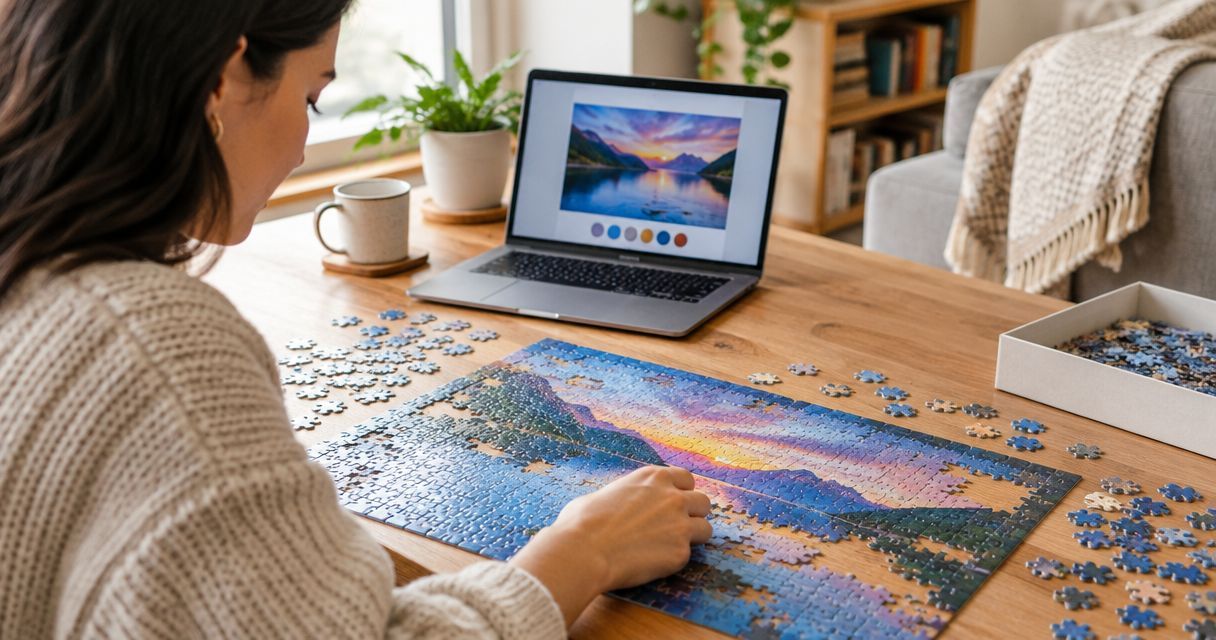
Personalised jigsaws come in wildly different piece counts, and the wrong choice turns a heartfelt gift into a puzzle that sits half-finished on a shelf. This guide ranks personalised jigsaw options by piece count and difficulty so you match the puzzle to the person solving it, not just the photo going on it.
TL;DR
- Personalised jigsaw piece count is the single biggest factor in whether a puzzle gets finished.
- A 35-piece personalised jigsaw suits toddlers; a 1000-piece version suits dedicated adult puzzlers.
- 63-piece large-format jigsaws work best for dementia care activities and hands that shake or tire.
- 500-piece personalised jigsaws hit the sweet spot for family game night in 2026.
- Match photo detail to piece count: busy images fall apart at high piece counts, not low ones.
Why this matters
Most people pick a personalised jigsaw the way they'd pick a photo mug: choose a nice picture, hit order, done. But piece count controls two things at once — how much of the photo survives being cut apart, and how long the puzzle takes to finish.
A face-heavy family photo cut into 1000 tiny pieces loses the very detail that made it worth printing in the first place. A simple pet portrait cut into just 35 pieces gets solved in under ten minutes and never gets touched again. Getting personalised jigsaw piece count wrong wastes both the photo and the goodwill behind the gift, which matters more than ever heading into 2026 gifting season when photo puzzles compete with a dozen other personalised options.
Pixa Prints treats piece count as a difficulty dial, not just a size option, and that dial is what this ranking works from.
What makes the best personalised jigsaw
- Piece size matched to hand and eye ability — toddlers and older adults both need bigger, chunkier pieces than a teenager solving alone at a desk.
- Image detail suited to the piece count — high piece counts need photos with texture and variety; low piece counts need bold, simple shapes.
- Contrast for the intended user — dementia care puzzles and young children both benefit from strong colour separation between sections of the photo.
- Realistic completion time — a puzzle nobody finishes in one or two sittings often never gets finished at all.
- Durability of the cut pieces — repeated handling by small hands or shaky hands needs pieces that hold their shape without fraying at the edges.
- A finished size worth keeping — some piece counts lend themselves to framing afterwards, others are built to be dismantled and boxed away.
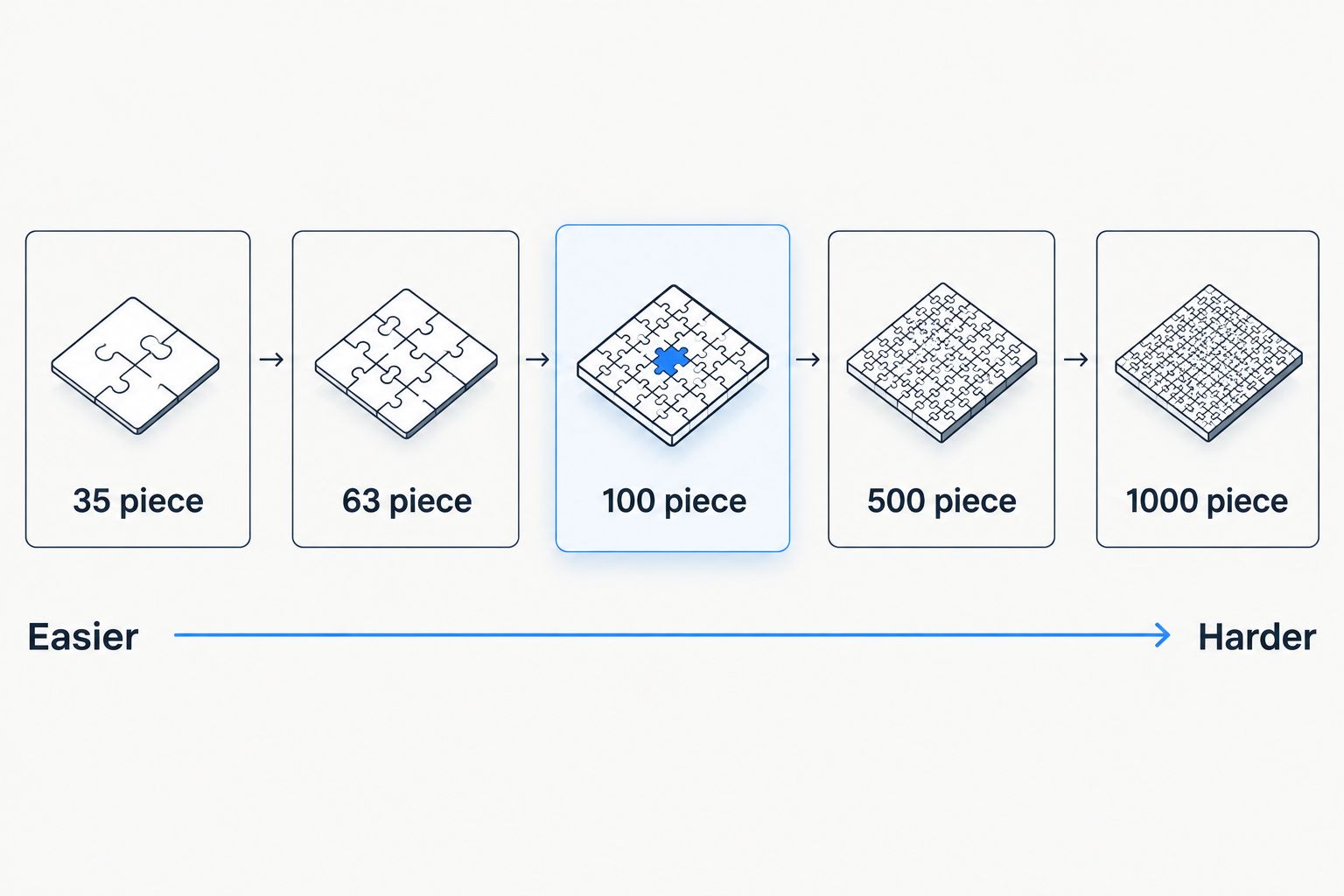
Piece count is really a difficulty dial, not just a size option.
Personalised jigsaws at a glance
| Tier | Best for | Standout feature | Key limitation |
|---|---|---|---|
| 35-piece | Toddlers and preschoolers | Chunky pieces, easy grip | Finished in minutes, no lasting challenge |
| 100-piece | Building confidence in school-age kids | Clear photo sections, steady pace | Too simple once a child hits age nine or ten |
| 63-piece large-format | Dementia care activities | Oversized pieces, high-contrast image | Not enough challenge for general adult use |
| 500-piece | Family game night | Balances challenge with a finishable session | Needs table space free for more than one sitting |
| 1000-piece | Adult puzzle enthusiasts and framing | Highest photo detail retention | Long completion time, fiddly small pieces |
1. 35-piece personalised jigsaw: best for toddlers and preschoolers
A 35-piece personalised jigsaw uses the largest, thickest pieces in the range, sized for hands that haven't fully developed fine motor control yet. The photo works best when it's one clear subject — a pet, a parent's face, a single toy — rather than a busy group shot that gets lost at this piece count.
35-piece jigsaw pros:
- Pieces are large enough that toddlers won't swallow or lose them easily
- Simple photos stay recognisable even with few pieces
- Finishes fast enough to hold a short attention span
35-piece jigsaw cons:
- Offers almost no challenge for children over five
- Limited photo detail means busy or cluttered images don't translate well
Best for: toddlers and preschoolers doing their first puzzle. Verdict: Buy if the recipient is under five; Skip for anyone older who'll finish it in one sitting and never pick it up again.
2. 100-piece personalised jigsaw: best for building confidence in school-age kids
Step up to 100 pieces and the puzzle stays achievable in a single sitting while introducing real problem-solving — sorting edges, matching colour blocks, working section by section. This tier suits school photos, holiday snaps, or a family portrait with two or three recognisable faces.
100-piece jigsaw pros:
- Long enough to teach patience without causing frustration
- Photos with two or three distinct colour zones work well
- A realistic gift for ages six to ten
100-piece jigsaw cons:
- Outgrown quickly by confident puzzle-solvers
- Fine facial detail in group photos still gets muddy
Best for: children building puzzle confidence. Verdict: Buy for the six-to-ten age bracket; Hold for anyone who's already comfortable with 300-piece puzzles.
3. 63-piece large-format personalised jigsaw: best for dementia care activities
This tier looks like a low piece count on paper but the pieces themselves are oversized and cut for grip rather than speed. Photo jigsaws built this way are widely used in dementia care settings because a high-contrast, familiar photo with fewer, larger pieces reduces frustration for people with limited fine motor control or shaky hands. The personalised photo jigsaws for dementia care activities guide covers photo selection for this specific use in more detail.
63-piece large-format jigsaw pros:
- Oversized pieces suit shaking or arthritic hands
- High-contrast, familiar photos reduce frustration and confusion
- Large images stay legible even with reduced vision
63-piece large-format jigsaw cons:
- Too simple for anyone without motor or vision limitations
- Fewer sourcing options for photos with lots of small detail
Best for: care home activities and family members supporting dementia care at home. Verdict: Buy for this specific use case; Skip it as a general adult gift.
4. 500-piece personalised jigsaw: best for family game night
Five hundred pieces is where most families land for a puzzle that's meant to be a shared activity rather than a solo task. It's substantial enough to spread across a coffee table for a weekend, small enough that a family photo or holiday snap still resolves clearly once finished.
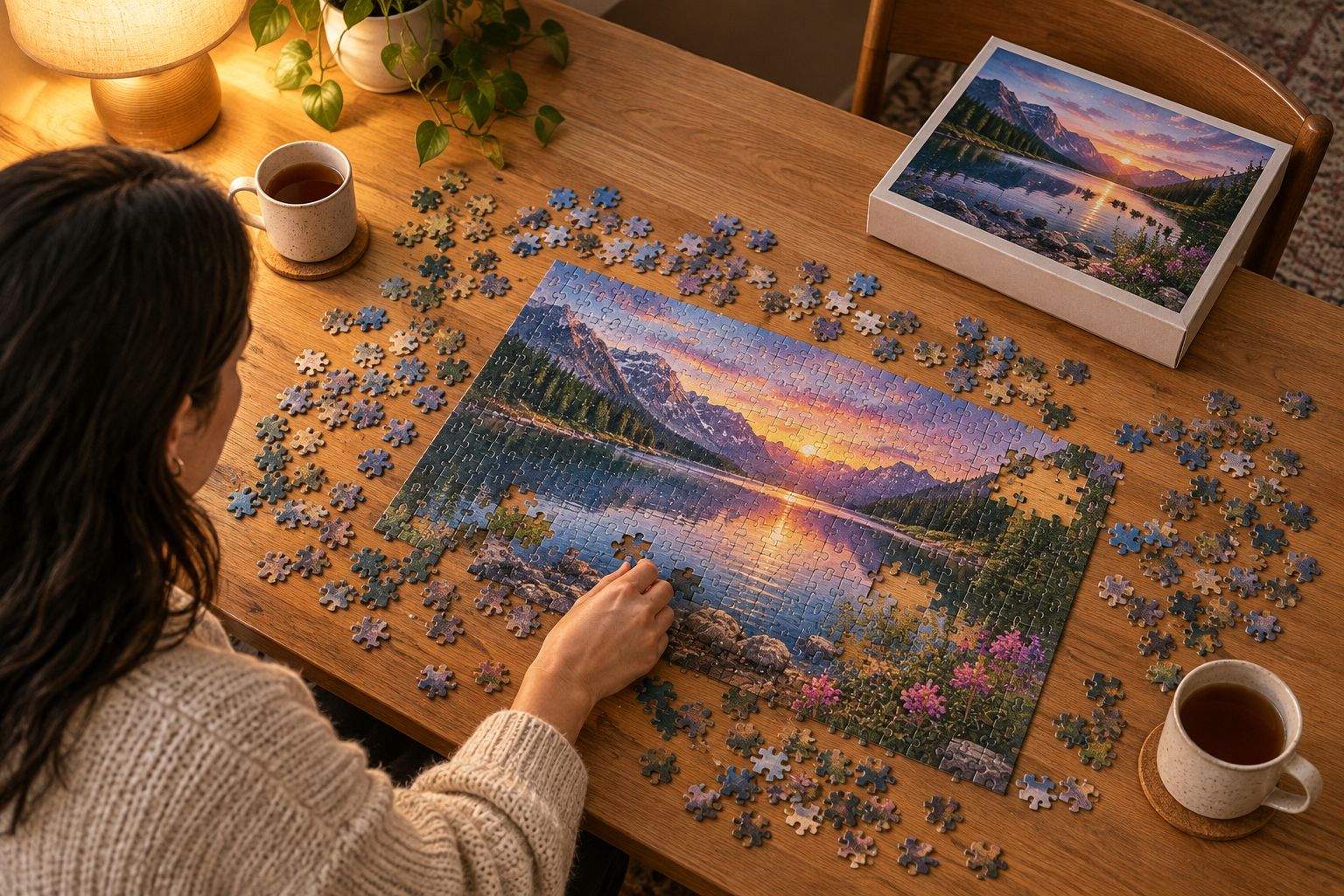
A 500-piece puzzle is built to be worked on across more than one sitting.
500-piece jigsaw pros:
- Long enough to fill several evenings without dragging on for weeks
- Group photos and landscapes both hold up at this detail level
- Works well as a shared activity rather than a solo one
500-piece jigsaw cons:
- Needs dedicated table space for the duration
- Some pieces inevitably go missing during longer projects
The personalised jigsaws for family game nights guide has more on picking photos that hold up at this piece count.
Best for: family game night and multi-evening group projects. Verdict: Buy — this is the tier most households should default to.
5. 1000-piece personalised jigsaw: best for adult puzzle enthusiasts and framing after completion
At 1000 pieces, image detail is at its finest and pieces are at their smallest, which makes this tier a project rather than an evening's entertainment. It rewards photos with genuine texture — landscapes, cityscapes, pattern-heavy scenes — where fine detail is the point rather than a liability.
1000-piece jigsaw pros:
- Highest level of photo detail retention in the range
- A satisfying long-term project for experienced puzzlers
- Finished puzzles are large enough to frame and display
1000-piece jigsaw cons:
- Small pieces are genuinely hard to handle for children or anyone with reduced dexterity
- Completion can take weeks, which discourages casual solvers
Best for: dedicated adult puzzlers and anyone planning to frame the result. Verdict: Buy for enthusiasts; Wait if the recipient has never finished a 500-piece puzzle before.
How we ranked these
Each tier is judged against the six criteria above — piece size for the intended hands, image detail matched to piece count, contrast, realistic completion time, piece durability, and whether the finished puzzle is worth keeping. No tier wins across every criterion; each earns its place by solving a different problem, which is why the ranking reads as a decision tree rather than a single winner.
Which personalised jigsaw piece count should you choose?
For most adult gift-givers in 2026, the 500-piece personalised jigsaw is the safest default — it's substantial enough to feel like a proper gift and finishable within a normal week. Drop to 100 or 35 pieces for children under ten, step up to 63-piece large-format for dementia care, and only go to 1000 pieces if you know the recipient already finishes puzzles for fun.
Turn a photo into a jigsaw
Upload a photo and pick the piece count that fits the person you're giving it to.
FAQ
What's the best personalised jigsaw piece count for kids?
For children under five, a 35-piece personalised jigsaw with large pieces works best. Children aged six to ten do well with 100 pieces, which introduces real problem-solving without causing frustration.
How many pieces should a personalised jigsaw have for adults?
500 pieces suits most adults as a shared, multi-evening activity in 2026. Experienced puzzlers who want more detail and a longer project should go to 1000 pieces.
Are large-piece jigsaws good for dementia care?
Yes, a 63-piece large-format personalised jigsaw with a high-contrast, familiar photo is a common choice for dementia care activities. The oversized pieces suit hands with reduced motor control.
How long does a 1000-piece personalised jigsaw take to finish?
A 1000-piece puzzle typically takes several sittings spread across weeks rather than a single evening. It's built as a long-term project, not a quick activity.
Can I frame a finished personalised jigsaw?
Yes, 500-piece and 1000-piece jigsaws are large enough once completed to frame and display. Smaller piece counts like 35 or 63 pieces are usually dismantled and reused rather than framed.
What photo works best for a personalised jigsaw?
Simple, single-subject photos work best at low piece counts, while detailed landscapes or textured scenes suit 500 to 1000 pieces. Busy group photos tend to lose clarity at very high piece counts.
Is a 500-piece jigsaw too hard for children?
For most children under twelve, 500 pieces is a difficult, lengthy project best attempted with adult help. Children solving alone generally do better with 100 to 300 pieces.
What's the easiest personalised jigsaw piece count?
35 pieces is the easiest tier, designed with large, chunky pieces for toddlers and first-time puzzlers. It finishes in minutes rather than hours.
One last thing
The detail trap catches most first-time buyers: a photo that looks sharp on a phone screen often loses its best details once cut into 500 or 1000 pieces, because busy backgrounds and small faces get split across piece edges. For anything above 300 pieces, pick a photo with one or two dominant colour zones rather than a photo with a lot going on — it's the single change that makes a high piece count personalised jigsaw actually get finished instead of abandoned halfway through 2026's gifting season.