
Personalised Jigsaw for Dementia Care: 2026 Guide
· 10 min read
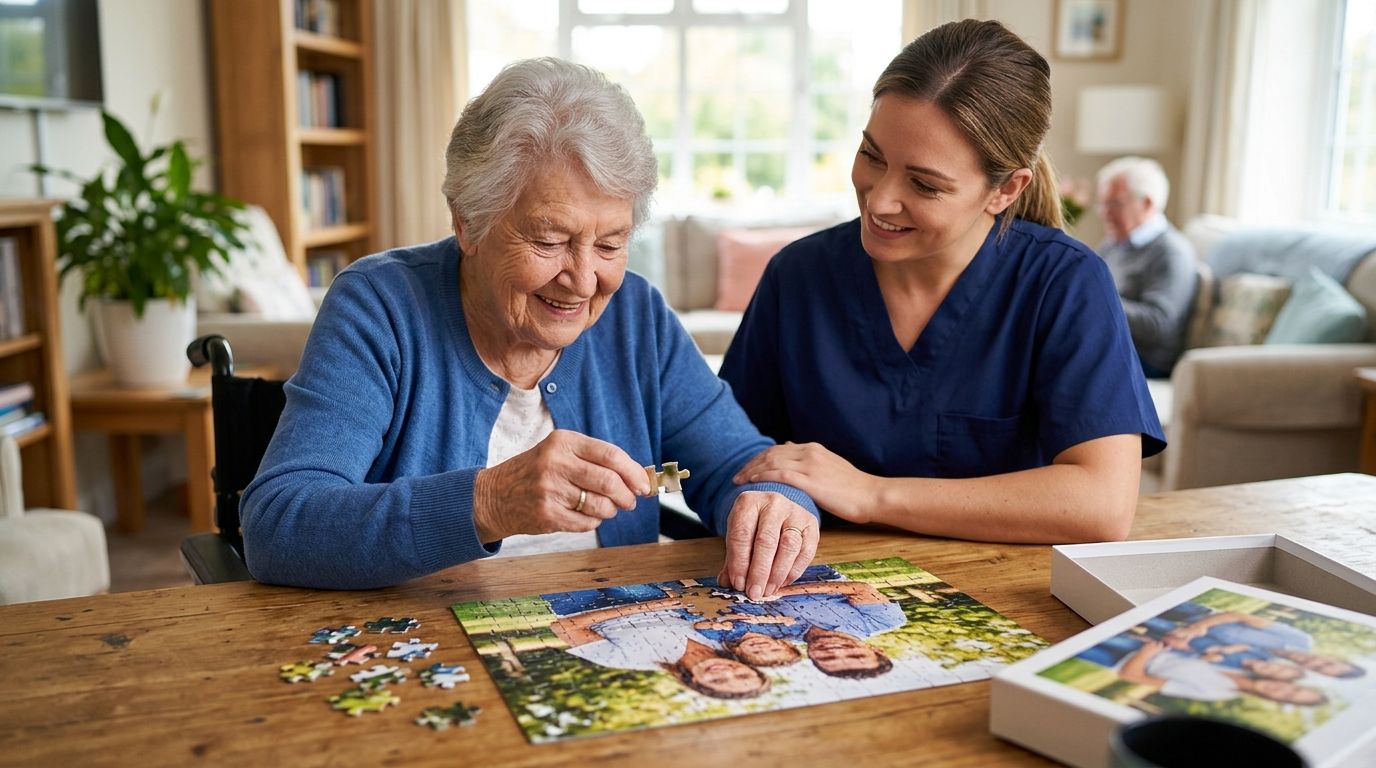
Personalised jigsaws for dementia care turn a single photograph a person already recognises — a wedding day, a dog long since passed, the seaside town they grew up in — into a puzzle built with fewer, larger pieces so the activity stays achievable rather than frustrating. Unlike a jigsaw bought for a grandchild's rainy afternoon, a dementia care jigsaw has to work with short attention spans, shaky hands and memory that comes and goes within the same session.
TL;DR
- A personalised jigsaw for dementia care works best with large, low-count pieces and one clear, familiar photo.
- Pixa Prints turns a single uploaded photo into a jigsaw without any design skill needed.
- Reminiscence beats testing: never correct a wrong piece, just talk about what's in the photo.
- Rotate three or four jigsaws through a weekly routine instead of repeating the same image.
Why personalised jigsaws matter for dementia care
Memory loss in dementia tends to hit recent events first and long-held, emotional memories last. A photo of a person's own wedding, their old house, or their children as babies reaches further into memory than any generic puzzle image ever will. That's the whole case for choosing a personalised jigsaw over a shop-bought one for this specific group.
Family carers searching for a personalised jigsaw for dementia care are usually not shopping casually. They've tried standard puzzles, found them either too fiddly or too dull, and are now looking for something built around a real memory rather than a stock photo of a lighthouse. If you're not sure which photo gift actually fits the situation, the guide on choosing a personalised photo gift for any occasion covers how to match the gift to the person rather than the event.
Care home activity coordinators have a slightly different need: they want something one team member can hand out to several residents in a session, with minimal setup and no risk of pieces going missing under a chair. Both groups end up at the same product for different reasons.
Choose photos that spark recognition, not staged shots
The photo matters more than the puzzle. A posed studio portrait rarely does as much work as a candid shot from an ordinary day.
- Pick one clear subject — a face, a pet, a house — not a busy group shot with ten people
- Favour photos from mid-life or childhood over recent ones; earlier memories tend to hold longer
- Avoid photos with heavy shadow or clutter in the background; the puzzle needs visual contrast to be solvable
- Ask family members which photo the person mentions unprompted; that's usually the strongest choice
- Skip filtered or heavily edited images — natural colour reads better once cut into pieces
Pick a piece count that matches the stage
A 1000-piece puzzle is a hobby for someone with time and steady hands. It's an obstacle course for someone in mid-to-late-stage dementia.
- Start with fewer, larger pieces for anyone with reduced fine motor control or limited attention span
- Increase piece count gradually only if the current level is finished with ease and interest, not struggle
- Keep the finished image simple — one subject reads faster than a landscape with dozens of details
- Reassess every few months; dementia progression means today's right-sized puzzle may need adjusting later
- Note down what worked in a simple log so every carer on rotation uses the same piece count
Set up the session so nobody feels timed or tested
How the activity is introduced matters as much as the puzzle itself. Dementia care sessions built around time pressure or correction tend to raise anxiety rather than lower it.
- Choose a quiet, well-lit table away from television noise or passing foot traffic
- Sit alongside rather than opposite, so the activity feels shared rather than supervised
- Offer the puzzle as something to do together, never as a test of ability
- Keep sessions short — 10 to 20 minutes is often enough before attention drifts
- Have the finished photo visible nearby as a reference, not hidden away
Guide the puzzle without correcting or quizzing
The instinct to fix a wrongly placed piece or ask who's in the photo usually backfires. Reminiscence-based activities work best when the conversation follows the person's lead.
- Talk about what's in the photo rather than asking the person to name it
- Let a wrong piece sit if it's not disrupting progress; move it later without comment
- Use open prompts like tell me about this place instead of direct questions with a right answer
- Praise effort and engagement, not accuracy
- Step back once the person is absorbed; hovering can interrupt focus more than help it
Ordering a jigsaw built from a single uploaded photo removes one variable entirely: you're not relying on a generic image and hoping it lands. Pixa Prints lets a family member or activities coordinator upload the exact photo that matters and turn it into a puzzle in minutes, which is a faster route than sourcing a printer that handles photo-to-puzzle conversion locally. It doesn't replace the manual groundwork above — it just removes the guesswork over which image to use.
Rotate the images so the activity stays fresh
One jigsaw repeated every week for months loses its pull, even with a photo the person loves. Rotation keeps reminiscence sessions from becoming routine box-ticking.
- Build a small rotation of three or four jigsaws around different life stages — childhood, a wedding, a favourite pet, a holiday
- Swap the active jigsaw every few weeks rather than leaving one out indefinitely
- Involve family members further afield in choosing photos; the guide on personalised photo gifts for long-distance grandparents has practical ways to gather images from relatives who can't visit often
- Keep a shared album, physical or digital, so new photos are easy to pull for the next jigsaw order
- Retire any jigsaw that's causing frustration rather than forcing it back into rotation
Log what works so every carer uses the same routine
Consistency across shifts and family visits matters more than any single clever technique. What calms a person on a Tuesday afternoon with one carer should work on a Thursday with another.
- Keep a one-page note per person: preferred photo subjects, best time of day, session length that works
- Record which prompts got a response and which caused agitation
- Share the note with anyone new joining the care rota, including occasional family visitors
- Update it as the person's stage changes rather than treating it as fixed
Which jigsaw option fits your care setting
| Option | Best for | Key limitation |
|---|---|---|
| Home-made photo puzzle (photo glued to a blank puzzle) | A one-off, low-cost trial before committing further | Pieces warp and the surface wears quickly with repeated handling |
| Personalised jigsaw printed from an uploaded photo | Ongoing care routines using real family photos | Needs a digital photo file and a few minutes to upload and order |
| Off-the-shelf reminiscence puzzle with stock imagery | Care homes without access to residents' personal photos | Generic scenes don't trigger the same recognition as a real photo |
Verdict: a personalised jigsaw for dementia care built from a real family photo consistently outperforms stock reminiscence puzzles on recognition — it's the difference between a puzzle of a cottage and a puzzle of their cottage.
Common mistakes families and care teams make
- Choosing the photo for sentiment rather than clarity. A treasured but blurry or dark photo may look wrong once cut into pieces, even if it means the most to the family.
- Buying one puzzle and expecting it to last forever. Interest fades with repetition; a rotation plan matters more than the first purchase.
- Turning the activity into a memory test. Asking whether they remember something, repeatedly, can cause distress rather than comfort.
- Ignoring piece count as the person's ability changes. A puzzle that was right six months ago may now be too fiddly or too easy.
- Overlooking the carer's own wellbeing. Supporting someone through dementia care is demanding on its own terms, and burnout among family carers is common enough that self-care apps for carers belong in the weekly routine alongside the activities themselves, not as an afterthought.
Turn a family photo into a jigsaw
Upload one photo and order a personalised jigsaw in minutes.
FAQ
What size jigsaw is best for dementia?
Fewer, larger pieces work best for most stages of dementia because they're easier to grip and place without frustration. As ability changes, piece count and image complexity should be reassessed rather than fixed.
How many pieces should a dementia jigsaw have?
There's no single right number; it depends on the person's current motor control and attention span, not their age or diagnosis date. Start low and only increase if the current puzzle is finished with ease.
Can personalised jigsaws help with dementia care?
Yes, personalised jigsaws support reminiscence-based activity by using photos the person already recognises rather than generic images. The goal is engagement and calm conversation, not completing the puzzle correctly.
What photos work best for a dementia jigsaw?
A single, clear subject with strong contrast works better than a busy group photo or a heavily filtered image. Photos from earlier life stages often hold recognition longer than recent ones.
Is jigsaw puzzling good for dementia patients generally?
Puzzling is one of several reminiscence-based activities used in dementia care alongside music and photo books. Its value comes from the conversation and recognition it prompts, not from finishing the puzzle.
How do you introduce a jigsaw to someone with dementia?
Sit alongside them in a quiet space, present it as something to do together, and talk about the photo rather than asking them to identify it. Keep the first session short and judge from there.
What's the best jigsaw for a care home with several residents?
A small rotation of personalised jigsaws, each built from a different resident's own photo, works better than one shared generic puzzle. It keeps the activity personal without requiring a different product for every person.
One last thing
The detail most families miss: order two copies of the same jigsaw the first time. One stays in daily rotation, the other sits untouched as a backup for the week the first one goes missing a piece or two under a chair — a small step that keeps a routine from collapsing over something that trivial.