
Photo Books for Family Reunions: 2026 Guide & Verdict
· 9 min read
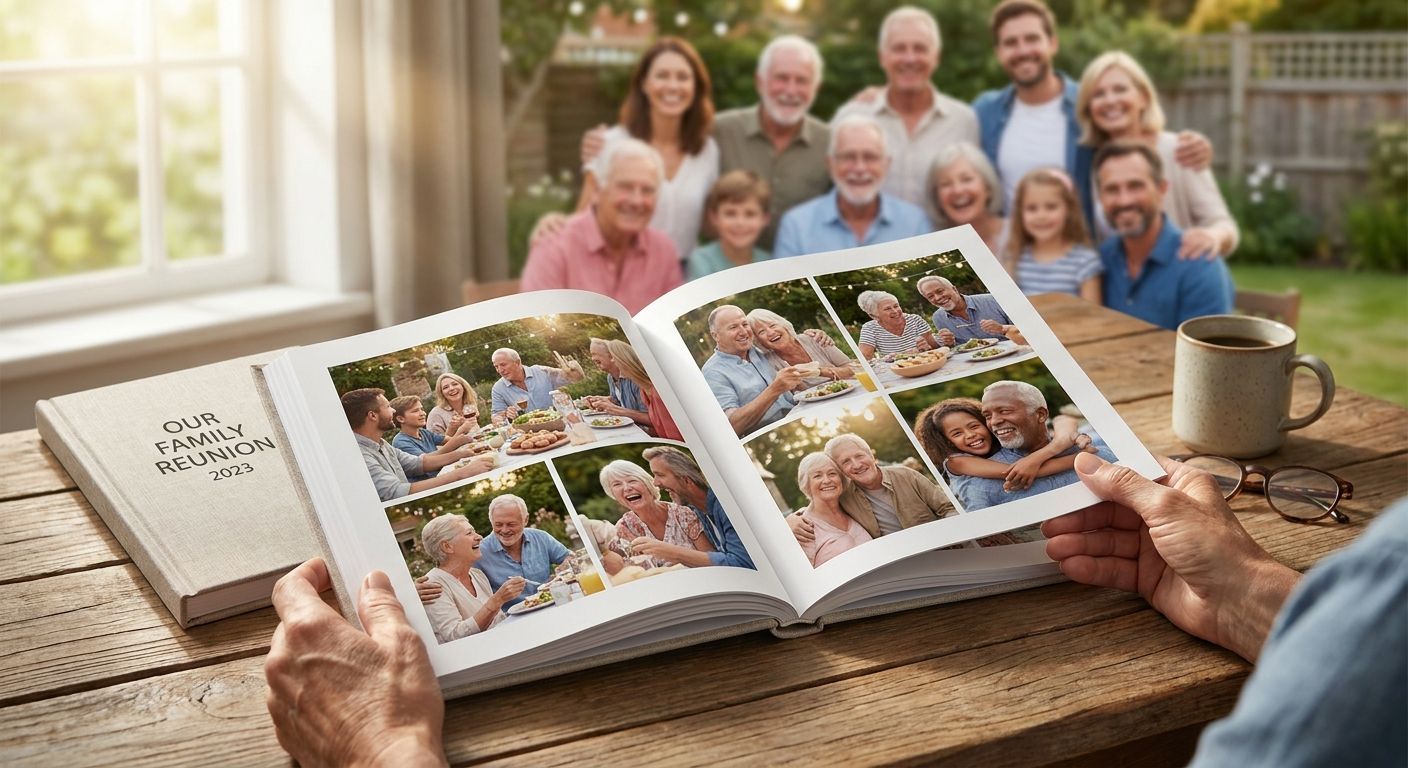
A family reunion photo book collects portraits, candid shots and group photos from every branch of the family into one printed keepsake, with the aim of giving relatives something to hold onto long after the event is over. Unlike a wedding album or a baby's first year book, a reunion photo book has to work for cousins who've never met, grandparents who want names not nicknames, and a guest list that might span 40 years of ages.
TL;DR
- Photo books for family reunions work best when captions name every person, not just the event.
- Order one proof copy before printing multiples for the whole family in 2026.
- Sort photos by family branch or by decade, not strictly by date taken.
- A hardcover layflat photo book handles large group shots better than a standard softcover.
- Pixa Prints photo books let you upload from a phone and design the whole layout in one sitting.
Why photo books matter for family reunions
A reunion happens once, maybe once every few years, and the group photo taken on the day is often the only time that exact combination of people is ever in one frame again. A photo book turns that into something every household in the family can actually keep on a shelf, rather than a photo that lives on one person's phone and never gets shared.
Reunions also produce photos from wildly different sources: someone's DSLR, a dozen phones, maybe a scanned print that an aunt brought along. A photo book is the one format flexible enough to hold all of that in a single story, which is why it beats a lone canvas print or a calendar for this specific job. If you're weighing up formats, choosing a personalised photo gift for any occasion covers how to match the format to the moment, but for a multi-generation event in 2026 a book is usually the right call.
Build a reunion photo book step by step
Set a theme before you collect photos
Deciding the angle first stops you dumping 300 random photos into one file and hoping it works.
- Pick one anchor: the decade, the family surname, or the location of the reunion
- Decide if it's one event or a multi-year retrospective
- Write a one-line story for the book before you open a single photo
- Agree the theme with whoever's coordinating the reunion, so nobody duplicates the job
Gather photos from every generation
The hardest part of any reunion photo book isn't design, it's collection. Phones, old prints, social tags and one relative's film negatives all need to end up in one folder.
- Create a shared folder or group chat and set a hard deadline for submissions
- Ask for photos from every branch of the family, not just the branch organising the book
- Include at least one photo per household so nobody's left out of the final layout
- Scan old prints at 300dpi or higher so they hold up in print
- For relatives who live far away, photo gifts for long-distance grandparents has tips on getting decent-quality images from people who aren't used to sharing full-resolution files
Sort photos by decade or by family branch
Chronological order isn't always the clearest structure for a family spanning five generations.
- Group by nuclear family unit if the reunion covers a large extended family
- Group by decade if the book is a retrospective rather than a single event
- Keep the current reunion's photos in their own clearly marked section
- Cut duplicates ruthlessly: one strong shot per moment, not six similar ones
Write captions that name every person
A photo book without names becomes a mystery within ten years, even for people who were there.
- Name every identifiable person left to right, not just "the grandkids"
- Include the year and location under group shots
- Add one line of context for older or archival photos, since memory fades faster than paper
- Keep captions consistent in tone and length across the whole book
Choose a layout that fits large group shots
Reunion photos are frequently wide, packed with people, and easy to ruin with a bad crop.
- Reserve full-page or double-page spreads for the main group photo
- Avoid tight grid layouts for any shot with more than six people in it
- Leave breathing room around faces near the edge of a group shot
- Use a layflat or panoramic-friendly layout so wide shots don't vanish into the spine
Order a proof copy before the full run
This is the step most families skip, and it's the one that saves the most regret in 2026.
- Order one proof copy and check every caption and every face crop before ordering more
- Check names are spelled correctly, especially less common spellings
- Confirm print colours match what you expect on screen, since screens run brighter than paper
- Get one other family member to proofread the draft before you finalise
Once the proof is approved, a Pixa Prints photo book lets you design straight from uploaded phone photos and reorder pages until the layout actually reads well. This is where the printing side matters more than the planning side, and it's worth getting right before ordering copies for every household.
Assign print copies before the reunion date
Printing one copy and passing it around isn't the same as ordering finished books for every household.
- Decide who's paying; splitting the cost across households keeps it fair for a big reunion
- Order a few weeks ahead of the event date, not the week before
- Consider one master copy for the oldest generation and standard copies for everyone else
- Bring the books to the reunion itself if timing allows, so it becomes part of the day
Comparison: photo book vs other reunion keepsakes
| Option | Best for | Key limitation |
|---|---|---|
| Photo book | The full event story across multiple generations | Takes longer to design than a single print |
| Canvas print | One standout group shot for a shared family home | Holds one or two images, not a narrative |
| Personalised calendar | Spreading reunion photos across the following year | Pages get replaced each year, not a permanent record |
| Loose photo prints | Families who prefer prints they can frame or swap | No captions or layout control |
| Personalised jigsaw | A fun activity gift alongside the main keepsake | Novelty format, not something to reread |
A photo book wins for family reunions because it's the only format built to hold a full, captioned story across generations rather than a single image or a rotating calendar page.
Turn reunion photos into a keepsake
Upload straight from your phone and design the layout in one sitting.
Common mistakes families make with reunion photo books
- Skipping the proof copy. Ordering ten copies straight to print means ten copies with the same spelling error or badly cropped face.
- Letting one person choose all the photos. Books that only reflect one household's camera roll leave other branches feeling like an afterthought.
- Ignoring older, lower-resolution photos. Archival prints get left out because they look rough next to a modern phone shot, but they're the ones nobody else can replace.
- Captioning only the current reunion. Historic photos need names and dates too; current memory won't last forever.
- Underestimating turnaround time. Ordering the week of the reunion in 2026 leaves no room for a reprint if the proof reveals a mistake.
FAQ
What's the best photo book format for a family reunion?
A hardcover layflat photo book works best for family reunions because it handles wide group shots without losing faces in the spine. Softcover options are lighter but less durable for a book meant to be passed around a large family.
How many photos should go in a family reunion photo book?
Most reunion photo books work well with 40 to 80 photos, enough to tell the story without repeating near-identical shots. Cutting duplicates during the sorting stage keeps the final book tighter and easier to read.
Is a photo book better than a canvas print for a reunion?
A photo book is better when you want to document the whole event across multiple generations, while a canvas print suits a single standout group shot for display. Many families order both.
How far in advance should I order reunion photo books?
Order at least two to three weeks before the reunion date so there's time to review a proof copy and reorder if anything needs fixing. Ordering the week of the event removes any margin for correcting a caption or a bad crop.
Should older, low-quality photos be included in the book?
Yes, archival photos should be included even if the resolution is lower than modern phone shots, since they're often irreplaceable. Scan them at 300dpi or higher and caption them with as much context as older relatives can give you.
Who should organise the photo collection for a reunion book?
One coordinator should own the deadline and the shared folder, but photos should be requested from every family branch, not just the organiser's household. This avoids a book that only reflects one side of the family.
Can I design a reunion photo book from my phone?
Yes, photo books can be designed entirely from phone photos without a laptop or professional camera, as long as the images are reasonably high resolution. Uploading directly from the phone that took the photos usually gives the best print quality.
What size photo book works best for a large extended family?
Larger square or landscape formats work best for extended families because they fit wide group shots without heavy cropping. Smaller formats suit a more intimate reunion with fewer group photos.
One last thing
The biggest predictor of whether a reunion photo book actually gets finished isn't the software or the printing, it's the deadline for photo submissions. Families that set a hard cutoff date get books ordered within a month of the reunion; families that leave it open-ended are still chasing photos from three cousins a year later. Set that deadline in 2026 before you set anything else.