
Best personalised 2027 calendars for family reunions
· 12 min read

Best overall: a whole-family highlights calendar. Best for sharing family history: a then-and-now calendar. Best for a simple design: a favourite-photo calendar. Choose your personalised 2026 calendar for family reunion memories by the story you want everyone to take home, rather than by how many pictures you can squeeze onto a page.
TL;DR
- Choose a whole-family highlights design for a personalised 2026 calendar for family reunion memories.
- Pixaprints lets you turn personal photographs into personalised calendars; choose your photo theme before designing.
- Use then-and-now pairings for family history, or seasonal photographs for a calendar that follows the year.
- Check household representation, face cropping and permission before you finalise your family photo calendar.
Why this matters
A reunion calendar has two jobs: help you follow the year and remind you of people you love. A lovely photograph still makes a poor choice if the crop cuts someone out or the same household appears on nearly every page.
Pixaprints personalised calendars suit families who want to turn their own photographs into a reunion keepsake. The strongest design starts with thoughtful photo selection, not extra decoration. Start with this guide to picking photos for a personalised calendar if your pictures are scattered across family messages and camera rolls.
The options below are photo themes, not separate product ranges. Choose the approach that fits your pictures, then check the calendar layout before committing to your design.
What makes the best personalised reunion calendar?
Judge a reunion calendar against these five criteria before choosing your theme:
- Family coverage: include different households and generations, not just the people who sent the most photographs.
- Clear faces: favour pictures where expressions remain recognisable after cropping.
- A coherent story: choose an organising idea that carries across 12 months without becoming repetitive.
- Everyday usefulness: keep the calendar information easy to read rather than letting decoration compete with it.
- Shared comfort: ask before including sensitive photographs, children's pictures or personal dates.
For a 2026 reunion keepsake, agree whether the calendar celebrates one gathering or the wider family story. That decision stops the design drifting between unrelated ideas halfway through.
The best reunion calendar themes at a glance
| Rank and theme | Best for | Standout feature | Key limitation |
|---|---|---|---|
| 1. Whole-family highlights | A shared keepsake for different households | Mixes group photographs with smaller family moments | Needs a deliberate check for missing relatives |
| 2. Then-and-now | Sharing family history across generations | Pairs older memories with recent photographs | Older images need careful preparation |
| 3. Seasonal family story | A calendar that feels connected to each month | Matches family photographs to the seasons | Requires a varied photo collection |
| 4. Household spotlight | A large extended family | Gives different family branches their own moment | Uneven contributions can make pages feel inconsistent |
| 5. Favourite-photo | A simple, uncluttered design | Lets a small selection of strong images lead | Leaves less room for the wider reunion story |
1. Whole-family highlights: best for a shared reunion keepsake
A whole-family highlights calendar combines the main gathering photograph with smaller moments: cousins catching up, grandparents laughing or someone helping prepare lunch. It tells the story of being together without making every month another version of the same group portrait.
For a Pixaprints personalised calendar, this is the default photo approach: gather your favourite pictures first, then work out which ones fit the chosen layout. Keep the large group photograph for a position where faces remain clear rather than forcing it into a narrow crop.
Whole-family highlights pros
- Includes both the big occasion and the quieter moments.
- Works with photographs contributed by different relatives.
- Gives you room to balance generations across the year.
Whole-family highlights cons
- The most photographed people can dominate unless you check coverage.
- Wide group pictures are awkward when the chosen image space has a different shape.
Best for: families giving the same reunion keepsake to several households.
Before finalising your 2026 calendar, make a simple household checklist beside the monthly photo plan. You do not need identical appearances for everyone, but you should be able to explain your choices without discovering that an entire branch is missing.
Verdict: Buy into this approach if you want the safest all-round choice.
2. Then-and-now: best for sharing family history
A then-and-now calendar brings older family photographs into conversation with recent ones. You might pair a childhood garden photograph with a reunion picture taken in the same place, or show relatives recreating a familiar pose.
The connection should be obvious without a lengthy explanation. If the layout does not suit paired photographs, alternate older and recent images through the year instead.
Then-and-now pros
- Gives older photographs a role beyond sitting in an album.
- Creates talking points between relatives of different ages.
- Adds variety without needing pictures from every season.
Then-and-now cons
- Faded, damaged or small originals need extra care before use.
- Some family memories are private or emotionally sensitive.
Best for: reunions where family history is part of the occasion.
Keep the original scan or photograph untouched and work on a copy. Check names with someone who recognises the people pictured; a confident guess is not a useful caption.
Avoid treating every older picture as a restoration project. If you cannot make faces clear without harsh editing, choose a different photograph or use it in a setting where a larger image works better.
Verdict: Buy into this approach for a family-history keepsake; skip it if the older pictures cannot support the design.
3. Seasonal family story: best for month-by-month variety
A seasonal family calendar connects photographs with the time of year: spring walks, summer gatherings, autumn outings and winter celebrations. The changing scenery gives each page a different feel while keeping the family at the centre.
Match the mood rather than forcing an exact date connection. A sunny picnic can suit a summer page even when it was not taken during that particular month.
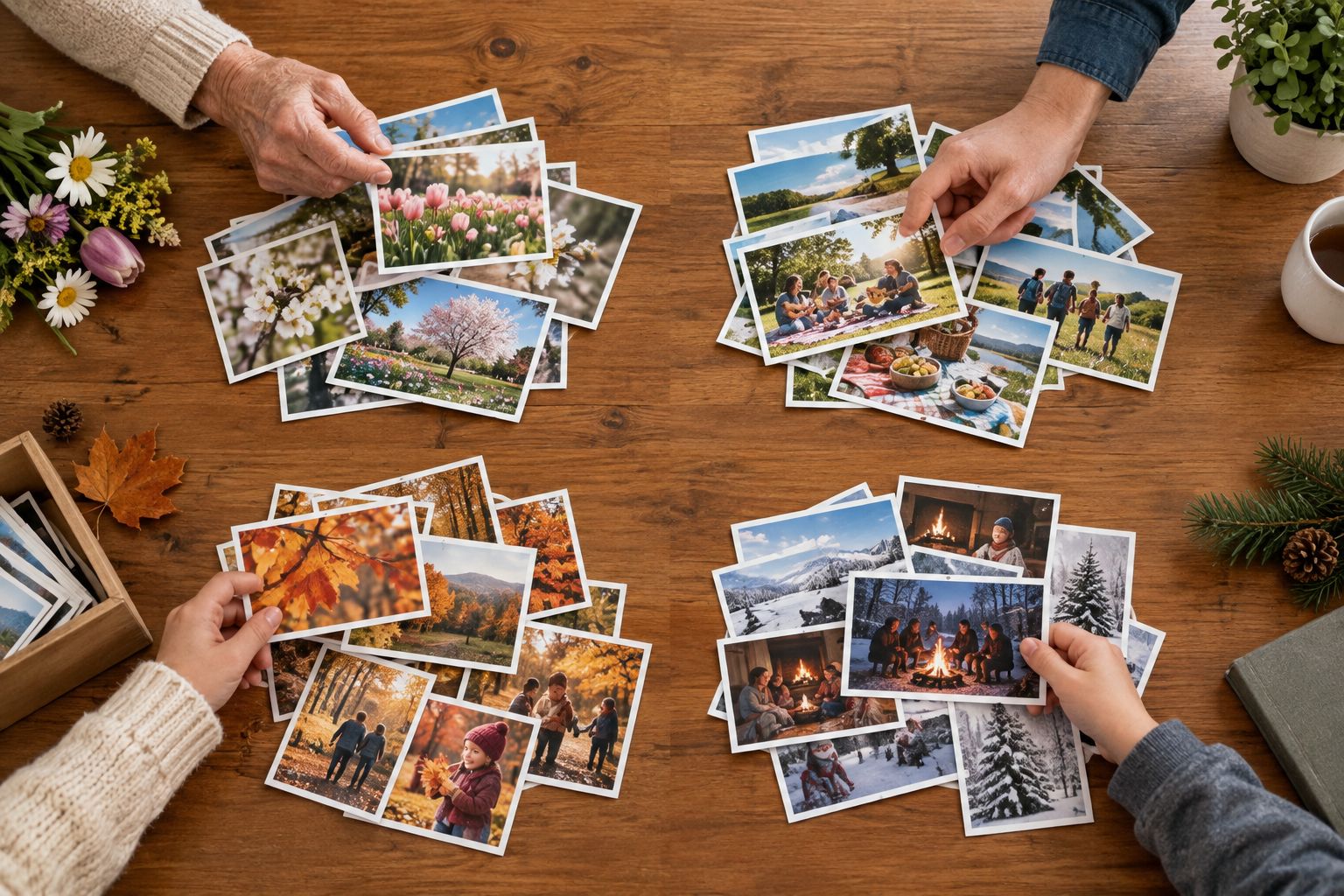
Seasonal photographs give the calendar variety without changing its family theme.
Seasonal family story pros
- Gives the year a natural visual rhythm.
- Encourages a mix of indoor and outdoor photographs.
- Makes room for everyday memories beyond the reunion itself.
Seasonal family story cons
- A collection dominated by one holiday can leave gaps.
- Seasonal matching can push a better family photograph out of consideration.
Best for: families with pictures from different outings and occasions.
For a 2026 calendar, decide whether seasonal consistency matters more than showing every favourite photograph. If finding suitable images becomes a struggle, switch to whole-family highlights rather than filling pages with weak pictures.
Verdict: Buy into this approach when your photo collection already spans the seasons.
4. Household spotlight: best for a large extended family
A household spotlight calendar gives different family branches their own space. One page might focus on grandparents, another on cousins, and another on a household living farther away.
This approach needs a shared brief. Ask each household for 3 candidate photographs, then choose the image that best fits the overall design rather than automatically using the first submission.
Household spotlight pros
- Makes family representation easier to plan.
- Lets relatives contribute photographs that matter to them.
- Includes people who missed the reunion itself.
Household spotlight cons
- Different image styles can make the finished calendar feel disjointed.
- Allocating pages becomes awkward when household numbers do not fit the plan.
Best for: extended families where inclusion matters more than a single-event story.
Keep the request simple: send original files, identify everyone pictured and confirm that the photograph can be included. Avoid asking one relative to contribute a formal portrait while another sends a dimly lit screenshot.
You do not have to assign one household to every month. Shared pages can bring cousins or siblings together, provided the chosen layout gives the photographs enough room.
Verdict: Buy into this approach for a large family; hold until every household has had a chance to contribute.
5. Favourite-photo: best for a simple design
A favourite-photo calendar uses a restrained selection of pictures, with each image doing more of the storytelling. Choose photographs with clear expressions and uncomplicated backgrounds rather than trying to include every reunion moment.
Simple does not mean impersonal. A candid photograph of someone making tea can mean more to your family than a carefully posed picture that nobody particularly likes.
Favourite-photo pros
- Keeps attention on expressions and relationships.
- Reduces the temptation to crowd each page.
- Makes photo selection manageable when time is limited.
Favourite-photo cons
- Gives fewer relatives an individual moment in the spotlight.
- Repeatedly using the same setting can make the year feel repetitive.
Best for: smaller families or organisers who prefer an uncluttered keepsake.
Start with 12 candidate photographs, then review them together rather than judging each in isolation. Swap near-duplicates for different people, settings or moods before you open the design.
Verdict: Buy into this approach for simplicity; skip it if your main aim is documenting every part of a large reunion.
How these calendar themes are ranked
Whole-family highlights comes first because it balances family coverage, photo variety and a clear reunion story. The remaining themes solve more specific problems: sharing history, following the seasons, representing households or keeping the design simple.
The ranking compares photo-planning approaches, not tested print quality or product specifications. Your strongest set of usable photographs should decide the final choice.
Turn your chosen theme into a finished calendar
Once you have chosen the story, make a page plan before uploading photographs to Pixaprints. A little sorting now is easier than replacing pictures throughout a nearly finished design.
- Collect originals: ask relatives for the original image files rather than screenshots of photographs.
- Plan months: assign a candidate image to each month and check the balance of people and settings.
- Check crops: inspect faces, heads and important details at the edges of every image space.
- Proof together: ask 2 relatives to check names, any personal dates and the overall family coverage.

For your 2026 design, check the year in the calendar itself rather than relying on a project name. If you include birthdays or reunion details, ask the relevant relatives to confirm them and check whether the chosen layout supports the text you need.
Which reunion calendar should you choose?
Choose whole-family highlights unless you have a clear reason to prefer another theme. It gives you room for the main reunion photograph, everyday moments and relatives who deserve a little more space in the story.
Choose then-and-now for family history, seasonal storytelling for a varied photo collection, household spotlight for a large extended family, or favourite-photo for simplicity. Pixaprints lets you create personalised calendars from your own photographs; the theme is what makes those pictures feel like a shared gift.
FAQ
What's the best personalised calendar theme for a family reunion?
Whole-family highlights is the best default theme for a reunion calendar. Combine the main gathering photograph with smaller moments, then check that different households and generations appear.
How do I plan a personalised 2026 calendar for family reunion memories?
Choose one photo theme, assign candidate pictures to the months and review the whole year before designing. Check the selected calendar year, image crops and family representation before finalising.
How many photographs should I collect for a family calendar?
Start with 12 candidate photographs if you want one main image for each month. Keep alternatives ready because some photographs will not suit the chosen image spaces.
Can I use old family photographs in a reunion calendar?
Yes, older family photographs can form part of a then-and-now theme. Work from a scan or careful copy, preserve the original and check that faces remain clear in the design.
How do I include relatives who missed the family reunion?
Ask absent relatives to contribute a photograph and include it within a whole-family or household spotlight theme. The calendar can celebrate the wider family rather than only those present on the day.
Should every month use a photo collage?
No, use a collage only when the chosen layout gives each photograph enough room. A single clear photograph is a better choice than several pictures with faces too small to enjoy.
What should I check before finalising a family calendar?
Check the calendar year, face cropping, names, any personal dates and permission to use the photographs. Ask another relative to review the design, especially for missing households or incorrectly identified people.
One last thing
Ask each household which photograph they would most like to see included. The answer gives you a better starting point than choosing only by sharpness or scenery: it tells you which memory matters to the people receiving the gift.
Then apply the practical checks. A meaningful photograph still needs a suitable crop and a place in the wider family story.