
Best framed prints from photos for narrow hallways 2026
· 13 min read
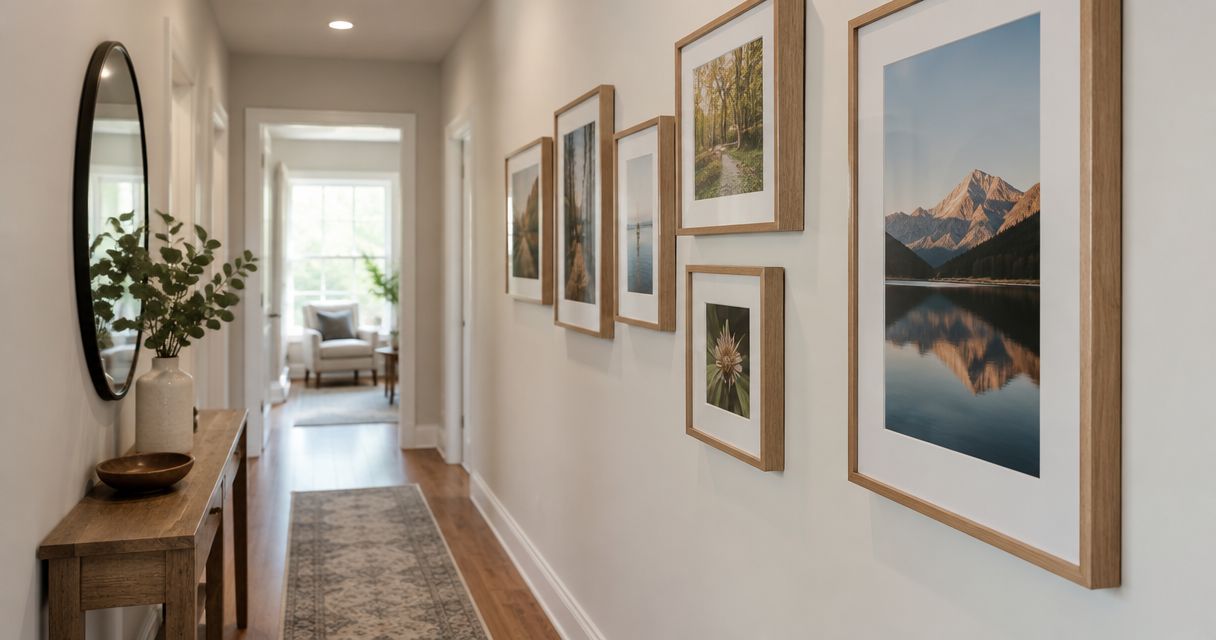
Best overall: a single portrait-format photo in a slim frame. Best for a long wall: a matching horizontal trio. Best for reusing a frame you own: a small print with a generous mount. This 2026 guide compares framed prints from photos by hallway layout, so you can choose a display that feels personal without crowding the route through your home.
TL;DR
- For framed prints from photos, choose a single portrait-format frame as the simplest narrow-hallway starting point.
- A matching horizontal trio suits long walls; a vertical pair suits short wall sections.
- Pixaprints suits people creating personalised photo gifts; choose hallway framing around your space and photographs.
- Test the full frame outline, door clearance and reflections before making holes.
Why this matters
A hallway display needs to work while you walk past it, open doors and carry shopping. The best arrangement leaves those everyday movements alone and gives your favourite photographs enough space to be enjoyed.
Choose the photograph and frame together. A landscape image squeezed into a portrait opening loses part of its story; a small photograph inside a wide mount takes up more wall than its print size suggests. Start with this guide to photo prints for framing and wall display, then compare the layouts below.
These recommendations rank display arrangements, not named frame products. That keeps the decision focused on your wall, your photographs and the framing details you need to check.
What makes the best framed prints from photos?
- Clear passage: the frame and hanging hardware stay out of the route used by people, doors and coats.
- Suitable proportions: the outer frame fits the usable wall section, not just the photograph inside it.
- Readable photographs: faces and important details remain easy to recognise from your usual viewing position.
- Controlled reflections: the position works with nearby windows and lights rather than reflecting them over the subject.
- A connected arrangement: repeated frame finishes, mount colours or photo themes give separate pictures a shared thread.
- Practical hanging: the fixings suit the wall, frame weight and hanging instructions.
Best hallway photo displays at a glance
| Rank and arrangement | Best for | Standout feature | Key limitation |
|---|---|---|---|
| 1. Single portrait frame | A narrow wall beside a doorway | Gives one photograph a clear focal point | Leaves little room for a wider family story |
| 2. Matching horizontal trio | A long, uninterrupted wall | Links related photographs along the route | Needs enough length for frames and gaps |
| 3. Small print with a generous mount | Reusing a suitable frame | Gives a modest photograph breathing room | The outer frame can still be large |
| 4. Vertical pair | A short, tall wall section | Uses height instead of spreading sideways | The upper image needs a viewing check |
| 5. Single collage frame | Telling a story within one outline | Groups several memories in one arrangement | Small openings can make details hard to see |
1. Single portrait frame: best for a narrow wall beside a door
A single portrait-format frame is the default choice for a narrow hallway in 2026. It gives you one clear focal point without requiring a gallery wall, and it suits a photograph that already has a strong vertical composition.
Choose a family portrait, a pet sitting upright or a travel photograph with a clear central subject. Keep the complete frame within the wall section rather than letting it visually compete with a door surround or light switch.
Single portrait frame pros:
- Gives one meaningful photograph your full attention.
- Makes alignment simpler than a multi-frame arrangement.
- Lets you assess the entire display with one paper template.
Single portrait frame cons:
- Cannot show several separate memories at once.
- A wide group photograph needs cropping or a different layout.
Best for: a narrow wall beside a doorway, especially when you have one photograph you love more than the rest.
Check the door at its full opening angle, including the handle. A frame that looks comfortable with the door shut still needs to work when the door is open.
Verdict: Buy a single portrait frame if one strong photograph is enough; skip it if cropping removes someone important.
2. Matching horizontal trio: best for a long hallway wall
A matching horizontal trio places three framed photographs in a row. Choose images connected by an occasion, location or subject: a favourite beach, the walk there and the family enjoying it, for example.
The frames do not need identical photographs to look connected. Repeating the frame finish and mount colour gives the arrangement consistency while letting each picture tell a different part of the story.
Matching horizontal trio pros:
- Gives related photographs a natural reading order.
- Breaks a long wall into a deliberate arrangement.
- Makes a family occasion feel like a short visual story.
Matching horizontal trio cons:
- Requires space for the complete row, including gaps.
- Needs careful alignment to avoid an uneven appearance.
Best for: a long, uninterrupted wall with no door, switch or radiator breaking up the intended row.
For a 2026 refresh, start with three photographs from the same outing rather than three unrelated favourites. Keep faces at a similar visual scale where possible; a close-up beside a distant group can make the sequence feel unbalanced.
Verdict: Buy a matching trio for a genuinely long wall; skip it if the final frame gets squeezed against an obstacle.
3. Small print with a generous mount: best for reusing a frame
A small photograph inside a generous mount gives the image a clear border. This is a useful route when you already own a suitable frame and want to make a new photograph work within it.
The important distinction is between print size, mount opening and outer frame size. For example, a 10 × 15 cm print does not create a 10 × 15 cm wall display once you add a mount and frame.
Small print with a generous mount pros:
- Gives a small photograph a defined place within a larger frame.
- Lets you build a display around an existing frame.
- Adds visual space around a photograph with a busy background.
Small print with a generous mount cons:
- Uses more wall space than the photograph alone suggests.
- Makes the visible subject smaller than a full-frame image would be.
Best for: reusing a frame whose outer dimensions already suit your hallway.
Check how much of the photograph the mount overlaps. Keep eyes, heads and other important details away from the opening edge, and do not assume a mount labelled for a print size reveals every part of that print.
Verdict: Buy a mounted arrangement when the existing frame fits; skip it when the mount makes your favourite faces too small.
4. Vertical pair: best for a short, tall wall section
A vertical pair stacks two framed photographs instead of spreading them sideways. It suits a wall section where a horizontal row would run into a doorway or another feature.
Choose images with a clear relationship: two portraits, two views from the same holiday or a favourite place in different seasons. Matching outer frame widths gives the pair a straightforward alignment point.
Vertical pair pros:
- Uses wall height rather than adding horizontal spread.
- Gives two related photographs equal importance.
- Fits a shorter wall section than a comparable horizontal pair.
Vertical pair cons:
- The upper photograph needs checking from normal viewing positions.
- A stack placed too high becomes awkward to enjoy close up.
Best for: a short, tall stretch of wall where both pictures remain comfortable to view.
Do not centre the lower picture first and add the upper one wherever it fits. Lay out the complete pair on paper, then judge the group as one display from both ends of the hallway.
Verdict: Buy a vertical pair when both images remain easy to see; skip it if the upper photograph feels stranded near the ceiling.
5. Single collage frame: best for several memories in one outline
A single collage frame brings several photographs together within one outer frame. It is a useful alternative to separate frames when you want a small family story without aligning individual pictures across the wall.
Choose the photographs around the openings rather than forcing every favourite into the arrangement. A simple portrait works better in a small opening than a distant group with lots of tiny faces.
Single collage frame pros:
- Keeps several photographs within one defined outline.
- Removes the need to space separate frames individually.
- Suits a collection linked by one person, place or occasion.
Single collage frame cons:
- Fixed openings restrict photo orientation and cropping.
- Small images lose detail when viewed while walking past.
Best for: a family story with several simple, easily recognised photographs.
For a 2026 family update, select the pictures before committing to an opening pattern. Check whether each image needs portrait, landscape or square space, then reject layouts that crop out the people you want to celebrate.
Verdict: Buy a collage frame for simple, connected images; skip it for detailed scenes that need individual space.
Check the fit before you order
The safest layout decision happens on the wall, not in a shopping basket. Use this sequence to check your preferred arrangement before choosing print dimensions and framing.
- Measure the wall. Record the usable width and height between obstacles. Measure the outer frame dimensions separately from its stated print size.
- Make templates. Cut paper to the complete frame outlines. For an A4 photograph, the paper itself measures 210 × 297 mm; a surrounding mount and frame add to that footprint.
- Check doors. Place templates with a wall-safe method, then open nearby doors fully. Include handles, coat hooks and anything else that moves towards the display.
- Check reflections. Look from your usual approach in daylight and with the hallway lights on. Move the templates if the intended position faces a distracting light source.
- Confirm fixings. Follow the frame and fixing instructions for your wall type and the complete framed weight.
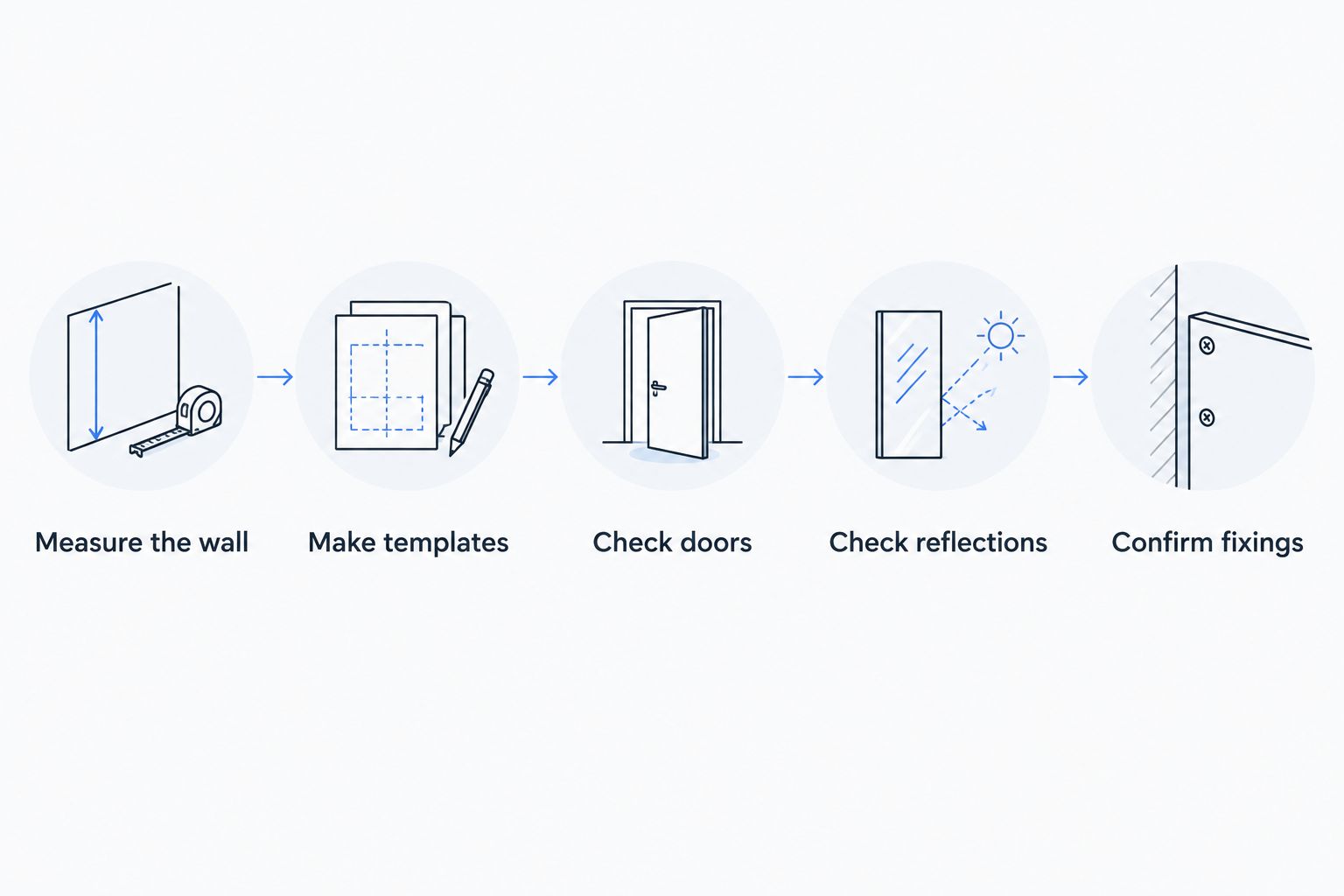
Test the complete frame outline before choosing its final position.
For a multi-frame layout, try a 5 cm gap between paper templates as a starting arrangement, not a required hanging standard. Adjust the gap until the pictures read as a group without crowding neighbouring features.
Do not choose frame depth from appearance alone. Check the frame's stated outer depth and the space taken by its hanging arrangement. A slim-looking border is not proof that the complete frame sits close to the wall.
Choose photographs that work in a passing space
A hallway gives you both close views and quick glimpses. Start with photographs whose main subject is clear without needing a long look: a recognisable expression, a pet's face or a favourite view with a strong focal point.
Use the original image file where possible, rather than a screenshot or a copy saved from a message. Inspect the actual crop before ordering, because the photograph's shape and the frame opening determine what remains visible.
For your 2026 selection, make a shortlist before editing every image. At Pixaprints, the starting point is your personal photograph; choose the memory first, then decide how you want to display it.
Keep colour treatment intentional. A mixture of colour and black-and-white photographs is a design choice, not a mistake, but repeating a frame or mount finish helps connect them. Avoid converting a cherished colour photograph simply to make it match a set.
How the layouts are ranked
This ranking prioritises clear passage, suitable proportions, readable photographs, reflections, visual consistency and practical hanging. The single portrait frame comes first because it requires the fewest separate placement decisions; the other options solve more specific wall or storytelling needs.
The ranking does not compare manufacturers, glazing specifications or print performance. Choose those details from the information provided for the actual print and frame you select.
Which hallway photo display should you choose?
Choose a single portrait frame if you are undecided. Pick one photograph, test the complete outline and leave neighbouring wall space clear before adding more.
Choose the matching trio only when your long wall comfortably accommodates the entire row. Use the vertical pair for a short wall, the mounted print for an existing frame, and the collage for several simple memories.
Keep the two decisions separate: Pixaprints helps you create personalised photo gifts, while the frame's dimensions, glazing and fixings need checking for your particular hallway.
FAQ
What's the best layout for framed prints from photos in a narrow hallway?
A single portrait-format frame is the best starting layout for a narrow hallway. It creates one focal point and is simpler to position than several separate frames. Check its complete outer dimensions against doors and nearby fittings.
Should hallway photo frames be portrait or landscape?
Choose portrait frames for narrow wall sections and landscape frames where the usable wall is wider. The photograph's composition matters too: do not crop a wide family group into portrait format if it removes people.
How big should framed hallway photographs be?
Choose the size by testing the complete outer frame outline on your wall. Print dimensions alone exclude the extra space taken by a mount and frame, so they cannot tell you whether the finished display fits.
Is a collage frame better than separate photo frames?
A collage frame is better when you want several related photographs within one outline. Separate frames give you more freedom over image size and spacing, while collage openings restrict orientation and cropping.
Can I use phone photos for a framed hallway display?
Yes, phone photographs can be used for a framed display when the image file supports the intended print size. Use the original file, check the crop and follow any image-quality guidance shown when ordering.
How do I stop reflections hiding my hallway photographs?
Start by checking the proposed position in daylight and with the hallway lights on. Move the display if a window or light reflects over the subject, and check the glazing information for the frame you choose.
Do I need matching frames for family hallway photos?
No, matching frames are optional. Repeating one element, such as mount colour or frame finish, gives different photographs a connection without requiring every part of the display to match.
One last thing
Before choosing your final photograph, stand where you normally enter the hallway rather than directly opposite the wall. A picture that looks lovely straight on needs to remain recognisable from that everyday approach.
For your 2026 hallway refresh, start with the memory you most want to see when you come home. That is a better reason to choose a photograph than filling an empty patch of wall.