
How to choose photos for your first home
· 11 min read

Choose photos for your first home by starting with memories you want to see every day, then checking that each image suits its room, crop and intended display. The best photo ideas for first home decorating feel personal rather than perfectly coordinated. Keep a meaningful but blurry picture for an album instead of making it the centrepiece of a large wall display.
TL;DR
- Photo ideas for first home decorating start with meaningful memories, clear images and a crop that keeps important details.
- Pixaprints lets you upload personal photos for canvas prints and photo books; choose your pictures before choosing a format.
- Start with one room, then build a shortlist around people, places or moving-in memories.
- Check original files and preview the crop before turning a favourite photo into wall art.
Why this matters
Your first home does not need a finished gallery on moving day. A favourite picture can give an unfamiliar room a connection to the people, places and experiences you already love. Start there, rather than searching for images that simply match the sofa.
If you are decorating your first home in 2026, choose photographs you enjoy now without expecting them to represent your whole life. You can leave space for new memories. For the practical display stage, the guide to photo prints for framing and wall display is a useful next read.
Choose the memory first and the display second. That keeps the decision personal while giving you a clear way to reject pictures that do not work in the space.
How do you choose photos for your first home?
Begin with a room you use regularly and a memory you would like that room to hold. Then compare possible photographs for emotional value, visible detail and cropping. A picture does not have to win every category, but it should earn its place rather than fill an empty wall.
Use these steps to turn a crowded camera roll into a manageable shortlist.
- Choose the room. Decide whether you are selecting a welcoming hallway image, a living-room focal point or something more private for your bedroom.
- Find the memory. Look for a person, place or moment that belongs in your everyday life. Include ordinary days as well as big occasions.
- Find the original. Use the original photo file where you have it, rather than a screenshot or a copy saved from a message.
- Check the crop. Try the intended shape and make sure faces, hands and meaningful background details remain visible.
- Test the setting. Look at the image beside the room's colours and furniture before deciding how to display it.
Keep the shortlisted files together in a clearly named folder, such as First Home 2026. This makes it easier to compare them without repeatedly searching through your entire photo library.
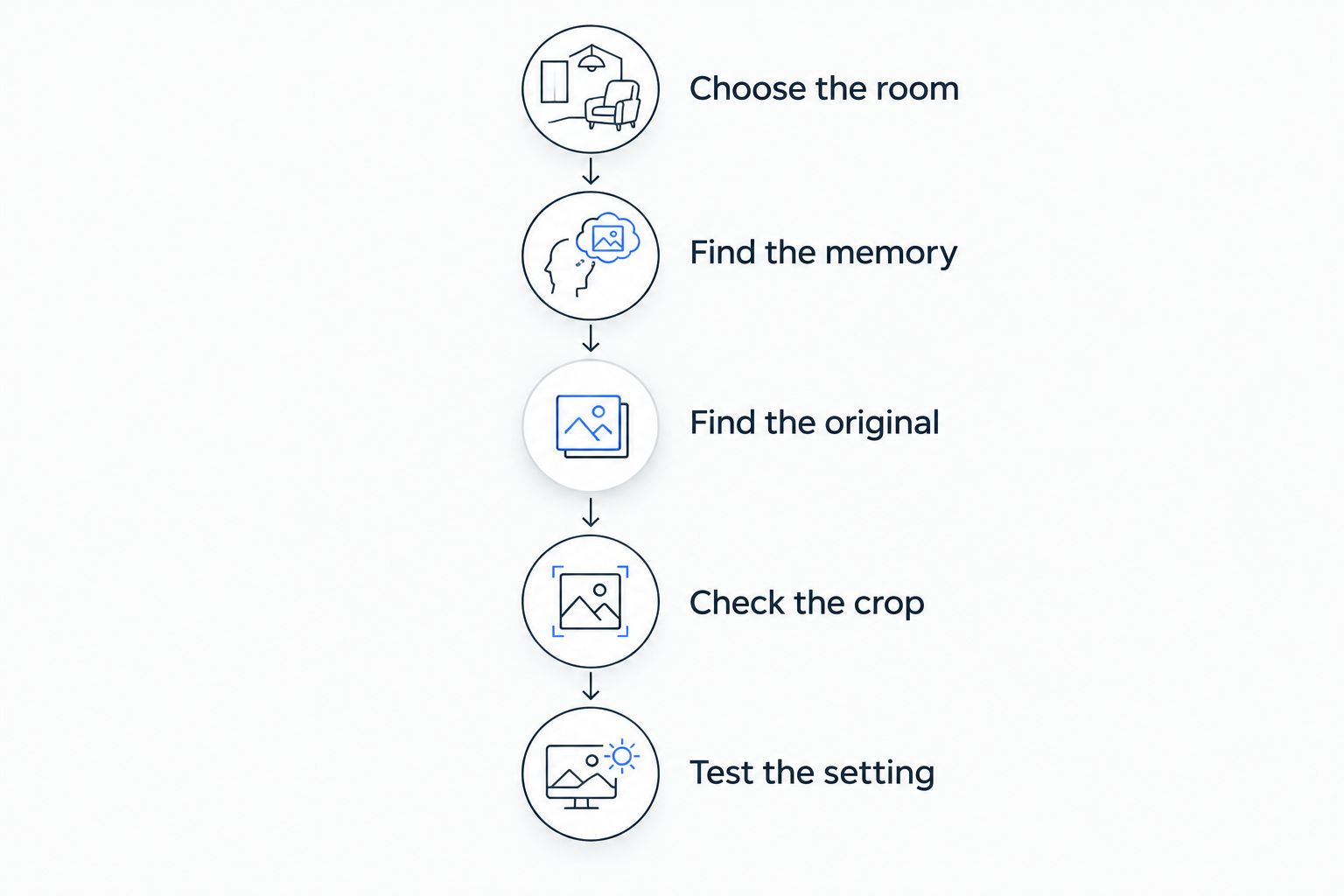
Choose a meaningful photograph before deciding how to display it.
Compare photo ideas before choosing a favourite
Different subjects tell different stories. Use the table to decide what you want a photograph to contribute, not to rank your memories by importance.
| Photo idea | Best for | What it adds | What to check |
|---|---|---|---|
| Family or friendship portrait | Keeping loved ones present | A direct connection to familiar people | Expressions, face detail and everyone's comfort with being displayed |
| Travel landscape | Remembering a meaningful place | A view connected to your own experience | Whether the crop removes the landmark or horizon you care about |
| Moving-day photograph | Marking a new beginning | A record of how your home story started | Visible addresses, paperwork and distracting clutter |
| Pet portrait | Celebrating everyday companionship | A familiar face with personal character | Sharp eyes, fur detail and space around ears |
| Everyday candid | Remembering ordinary happiness | A moment that feels like your actual life | Motion blur and whether the scene still reads clearly |
There is no need to choose a single subject for the whole home. A landscape in the living room and a candid beside your bed can belong together because both mean something to you.
Start with memories you want to live with
A photograph can be important without being one you want to see every morning. Ask how the image makes you feel now, not just whether it records a milestone. Choose pictures that suit the life you are making in your new space.
Try a shortlist of 3 photos for one room. This is a starting exercise, not a decorating rule: one person-focused image, one place-focused image and one everyday moment give you different stories to compare. Pick the one you would miss most if it disappeared from the shortlist.
If you share your home, invite the other person into that choice. A photograph of a shared walk or an ordinary meal can say more about your relationship than a formal portrait neither of you especially likes.
For your 2026 move, take a few pictures before the rooms are finished. The empty corner, first meal and unpacked boxes record a stage you cannot recreate once everything is settled. Keep them even if you choose older memories for the walls.
Match the photograph to the room
Think about how you experience the space. A hallway photograph greets you as you come home; a bedroom image stays close to your private routines. You do not need strict design rules, but you do need a reason for placing a particular memory there.
In a living room, stand where you usually sit and imagine looking at the picture from that position. A photograph full of tiny background details asks for closer viewing than an image with a clearly recognisable subject.
For a bedroom, choose a picture you genuinely want nearby rather than using the space for leftovers from another display. A quiet landscape, a loved one's portrait or an ordinary happy moment can all work. The decision is personal, not a rule about which subjects belong in bedrooms.
Keep private details in mind in shared areas. Check moving-day pictures for house numbers, keys, documents and readable labels before putting them somewhere visitors will see. Crop out details you do not intend to share.
Check the original file and the crop
A photo that looks pleasing on your phone still needs a closer look before printing. Open the original file and examine the important subject, especially faces and eyes. Look for missed focus, motion blur or editing that has removed detail.
Do not choose a larger display to rescue a blurry photograph. Enlargement does not restore detail that the original image lacks. If the memory matters more than the image quality, consider keeping it in a photo book or choosing a different frame from the same moment.
Compare 2 crop versions of the same image before settling on the layout. Try a wider view that preserves the setting and a tighter view that brings the subject forward. Keep the version that tells the story without losing something important.
Watch the edges. A crop that clips someone's hand or squeezes a pet's ears against the boundary can feel accidental even when the centre looks good. Leave room around details that need to stay intact, and check the preview for the particular format you select.
Keep your original untouched and save edits separately. A file named First Home 2026 Edited is easier to distinguish from the original when you return to it later.
Choose a display that suits the photograph
Decide whether the image needs to be visible across a room or enjoyed up close. This separates a wall-display decision from an album decision and prevents you from treating every favourite photograph as a potential centrepiece.
| Display option | Best for | Main benefit | Main limitation |
|---|---|---|---|
| Framed photo print | A picture you want to display individually | Gives one memory a defined place | Frame shape and visible opening affect the crop |
| Canvas print | A photograph intended as wall art | Makes the image part of the room | Important details need careful placement near the edges |
| Photo book | A sequence of connected memories | Keeps context and neighbouring moments together | The photographs are not continuously visible |
Pixaprints is for people who want to turn personal photographs into custom canvas prints or photo books. Those formats serve different purposes: a canvas puts a selected image on display, while a book gives a longer story somewhere to live.
Pixaprints offers personalised photo printing, but selecting a format cannot fix a poor source photograph. Make the picture decision first. Then use the format that supports the way you want to enjoy it.
Why photo choices vary from home to home
The right photograph depends on what you want to remember and where you intend to put it. Use these factors to explain your own choice rather than copying a finished room you have seen elsewhere.
- Personal meaning: A familiar street can matter more to you than a dramatic view from somewhere you have never visited.
- Room use: Public and private spaces create different decisions about intimacy and visible personal details.
- Image quality: Focus and preserved detail determine whether the file supports the display you have in mind.
- Image shape: Portrait, landscape and square compositions keep or lose different parts of the scene when cropped.
- Shared preferences: Everyone living in the home should feel comfortable with photographs in shared spaces.
If you are planning your rooms in 2026, treat your shortlist as editable. You can love a picture and still decide it belongs in a book rather than above the sofa.
Should all your home photos have the same style?
Your home photos do not need the same style. A shared subject, colour or frame approach can connect a group, but do not discard a meaningful image simply because it looks different. Judge the photographs together before deciding whether anything needs changing.
Are phone photos good enough for your first home?
Phone photos are suitable when the original file contains the detail your chosen display needs. Check focus and cropping rather than assuming that every phone image will work at every size. Use the original file whenever it is available.
Should you include photos of the new home itself?
Include photos of your new home if you want to remember its beginning. An unfinished room or the first meal captures something different from a polished photograph taken after decorating. Save both stages and decide later which belongs on display.
FAQ
What are the best photo ideas for first home decorating?
The best photo ideas for first home decorating are meaningful portraits, favourite places and everyday memories that suit your rooms. Choose a clear original image and check its crop before deciding on a display.
How do I choose between several favourite photos?
Choose the photograph you most want to see in that particular room. Compare emotional meaning, visible detail and cropping rather than trying to identify the most impressive picture.
Can I use a screenshot as a photo print?
Use the original photograph instead of a screenshot whenever you have it. A screenshot can contain less image detail or unwanted interface elements, so inspect it carefully if it is your only copy.
Should I put family photos in the living room or bedroom?
Put family photos where you want to enjoy them and where the people pictured are comfortable being displayed. A living room is shared space, while a bedroom offers a more private setting.
Do all my photos need to be black and white?
Your photos do not all need to be black and white. Keep colour when it contributes to the memory, and compare edited versions before committing to a consistent style.
Is a canvas print better than a photo book for first-home memories?
A canvas print suits a photograph you want on display; a photo book suits a sequence you want to revisit. Pixaprints offers both, so choose according to how you want to enjoy the memories rather than expecting one format to do everything.
What should I photograph when I move into my first home in 2026?
Photograph the moments you want to remember from your 2026 move, including empty rooms, unpacking and your first meal. Check for visible personal information before using those photographs in a shared display.
One last thing
Before you tidy every corner, photograph the home as it is. The half-unpacked room is part of the memory, not a failed version of the finished space. Save that image beside a later photograph taken from the same viewpoint; together, they tell the story of making the place yours.